Nisha wants to understand what happens when AI enters the workplace
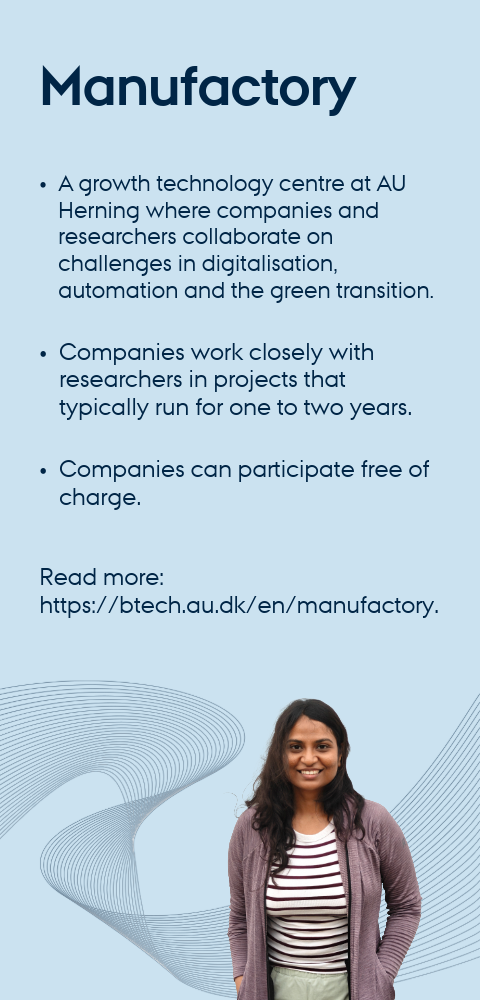
Through the Manufactory growth technology centre, PhD student Nisha Hemantha Raju gained early access to companies, employees and data. This has enabled her to refine and sharpen her research into how AI is being used in companies.

Originally from India, Nisha holds two master’s degrees from the United States. With a background in both electrical engineering and technology management, she was looking for a research environment that could bridge engineering and social science theories.
She found it at the Department of Business Development and Technology at Aarhus University in Herning, where she is now a PhD student.
She has been living in Denmark for a year. She was prepared for the rain, but the strong winds of western Jutland took her by surprise. She is still taking those one day at a time.
Exploring AI in practice
In her PhD project, Nisha examines how generative AI tools are being integrated into companies’ day-to-day work.
Among other things, she looks at how employees experiment with using language models to proofread emails, structure meeting notes and handle confidential information responsibly.
For Nisha, close contact with companies is essential to understanding how AI tools are actually being used in practice. Through Manufactory – a growth technology centre at AU Herning where researchers and manufacturing companies work together on specific challenges – she gained access to companies and employees early in her PhD.
This has had a direct impact on the development of her research:
“I’m particularly pleased that I had this opportunity so early in my PhD. It has meant that I’ve been able to continuously adjust and sharpen my research question. It would have been much more difficult if I had had to establish all the contacts myself from scratch, with the risk of being pulled in many different directions,” Nisha explains.
Less administration, more research
Close collaboration with companies involves more than simply establishing contact. Agreements on confidentiality and access to data also need to be in place. This is where Manufactory has made a significant difference for Nisha.
“Because Manufactory formalises the collaboration, clear agreements with the companies are already in place, so I know from the outset what kind of access I have,” Nisha explains, adding:
“It can take a long time to establish contact with companies and put agreements such as confidentiality agreements in place. Through Manufactory, the process is more structured. This means I can spend less time on administration and get started on the research itself more quickly.”
Companies open their doors
Having studied in the United States and worked for the technology company Intel, Nisha has been struck by the openness of companies in central and western Jutland.
“Even within Intel, it was incredibly difficult to gain access to data across departments. But through Manufactory, I’ve found – and I think this may also be part of Danish culture – that people are very open. Particularly when it comes to interviews, employees are very willing to talk and share details about their day-to-day routines,” she says.
These conversations give Nisha insight into how employees actually use AI, the opportunities they see and the challenges they encounter along the way. At the same time, the companies gain new knowledge about a technology that is already changing a wide range of work tasks.
Nisha currently collaborates with several manufacturing companies, including Arla. Her PhD project is expected to be completed in 2028.